The Protestant Reformation could never have happened if not for three key factors that paved its way. These three events were the main set-ups for the Reformation, and if any one of them had not occurred, there’s a good chance that the Reformation would never have occurred either.
The first event was the Renaissance; an important key to setting up the Reformation. “The term ‘Renaissance’ literally means ‘rebirth’ and is the period in European civilization immediately following the Middle Ages, conventionally held to have been characterized by a surge of interest in classical learning and values. The Renaissance also witnessed the discovery and exploration of new continents, the substitution of the Copernican for the Ptolemaic system of astronomy, the decline of the feudal system and the growth of commerce, and the invention or application of such potentially powerful innovations as paper, printing, the mariner's compass, and gunpowder. To the scholars and thinkers of the day, however, it was primarily a time of the revival of classical learning and wisdom after a long period of cultural decline and stagnation.” (source) “The Renaissance was the time in history when people began thinking, reading, and reasoning for themselves-apart from the Roman Catholic Church.” (Jim 62)
Another important factor leading to the Reformation was the decline of the papacy. “After the reign of Pope Innocent III (1198-1216,) the papacy lost much of its power and prestige, and starting at the beginning of the fourteenth century, it took a nose dive. …The papacy was weighted down with corruption, immorality, materialism, and secularism, so much so that at the close of the fifteenth century, it appeared there was little chance for reformation from within.” (Jim 59) The lower church leaders also became corrupted. The church was not the same, and many European believers thought that the church and Europe both were under God’s judgment. (source, Jim 59)
Peter Waldo, John Wycliffe, Jan Hus, Johann Gutenberg, and Girolamo Savonarola all paved the way for Martin Luther’s teachings in the 1500s. Peter Waldo’s followers were excommunicated, persecuted, and burned as heretics. John Wycliffe attempted to translate the Bible into English, creating the Wycliffe Bible. Jan Hus was burned at the stake, the fire being fueled by his own books. Johann Gutenberg developed movable type, so the Reformer’s teachings could be spread. It is estimated that he printed about 180 copies of the Bible. Girolamo Savonarola sent kids to collect all the worldly items that were distracting people from living in a godly manner. The pile of junk was 15 stories high! (source)
The final event that began the Protestant Reformation occurred on October 31, 1517, when Martin Luther nailed his 95 Theses on the Wittenberg church door. He protested Johann Tetzil’s selling of indulgences, and accused the church of heresy after heresy. However, the Roman Catholic Church was stubborn and condemned him as a heretic. This caused a huge outrage in Europe, and thus started the Protestant Reformation. (source, source, Jackson 69, 74)
Works Cited
Jackson, Dave & Neta. Hero Tales. Minneapolis, Minnesota: Bethany House Publishers. 1996.
Jim Bell, James. Complete Idiot's Guide to the Reformation & Protestantism, The. Indianapolis, Indiana: Alpha Books. 2002.
Friday, December 5, 2008

Saturday, November 22, 2008
Louis XIV (The Sun King of France)
King Louis XIV was born on September 5, 1638. “He ascended to the throne a few months before his fifth birthday, but did not assume actual personal control of the government until the death of his prime minister (Premier ministre), the Italian Jules Cardinal Mazarin, in 1661.” (source)
“Among many names, Louis the XIVth was also popularly known as The Sun King (in French le Roi Soleil) because of the idea that, just as the planets revolve around the Sun, so too should France and the court revolve around him. As a result, he was commonly associated with Apollo Helios, the Greco-Roman god of the Sun.” (source)
In 1660, the king married Maria Theresa. He was kind to her, but very unfaithful. He pursued his sister-in-law, then her maid-of-honor, then that maid’s friend, then the governess that friend hired for her children. The governess was Madame de Maintenon, and strangely enough, she became friends with the queen. In 1683, the queen died in her arms, and Madame de Maintenon secretly married Louis XIV. However, she could not become the queen. (source)
“In 1667 Louis XIV decided to move the royal household and government from Paris to Versailles. The center of his new palace was the hunting lodge his father had built in 1624. Built in a Boroque style, the Palace of Versailles was enlarged by architects Le Brun and Le Vau. King Louis XIV, the Sun King, had an enormous influence on the art and architecture of the time. Boroque architecture was fairly geometric which was ‘in keeping with the French political system—absolute monarchy personified by King Louis XIV.’ Because he is referred to as the Sun King, the architects gave the palace a room with ‘solar illusions.’ This Hall of Mirrors added to the elegant and majestic quality of the Boroque palace. Many years later in 1919, Germany ended the war by signing the Treaty of Versailles in the Hall of Mirrors. Another characteristic element of the Boroque time period was the elaborate gardens. To enhance his Palace of Versailles, King Louis XIV hired landscape architect Andre Le Notre to design the Boroque gardens surrounding the large estate. Pools and fountains, which also bedeck the vast landscape, are other features relevant to Boroque style. In sum, the king’s influence on architecture of the time is extremely evident in the Palace of Versailles.” (source)

There was also quite a bit of war during the reign of Louis XIV. The Thirty Years War ended in 1648, and from 1648-1653, there was civil war and unrest. In 1658, England helped France defeat Spain. In 1667, there was the War of Devolution with Spain, from 1688-1697, the Nine Years War, and in 1701-1714, the War of the Spanish Succession. (source, Lewis 76)
Between 1701-1712, four of the king’s loved-ones died. He filled his final years with persecution of the Protestants, and on September 1, 1715, King Louis XIV died from gangrene. (McConville 20)
Works Cited
Lewis, W. H. The Splendid Century: Life in the France of Louis XIV. Prospect Heights, Illinois: Waveland Press. 1953.
McConville, Brendan. The King’s Three Faces: The Rise and Fall of Royal America, 1688-1776. Chapel Hill, North Carolina: University of North Carolina Press. 2006.
“Among many names, Louis the XIVth was also popularly known as The Sun King (in French le Roi Soleil) because of the idea that, just as the planets revolve around the Sun, so too should France and the court revolve around him. As a result, he was commonly associated with Apollo Helios, the Greco-Roman god of the Sun.” (source)
In 1660, the king married Maria Theresa. He was kind to her, but very unfaithful. He pursued his sister-in-law, then her maid-of-honor, then that maid’s friend, then the governess that friend hired for her children. The governess was Madame de Maintenon, and strangely enough, she became friends with the queen. In 1683, the queen died in her arms, and Madame de Maintenon secretly married Louis XIV. However, she could not become the queen. (source)
“In 1667 Louis XIV decided to move the royal household and government from Paris to Versailles. The center of his new palace was the hunting lodge his father had built in 1624. Built in a Boroque style, the Palace of Versailles was enlarged by architects Le Brun and Le Vau. King Louis XIV, the Sun King, had an enormous influence on the art and architecture of the time. Boroque architecture was fairly geometric which was ‘in keeping with the French political system—absolute monarchy personified by King Louis XIV.’ Because he is referred to as the Sun King, the architects gave the palace a room with ‘solar illusions.’ This Hall of Mirrors added to the elegant and majestic quality of the Boroque palace. Many years later in 1919, Germany ended the war by signing the Treaty of Versailles in the Hall of Mirrors. Another characteristic element of the Boroque time period was the elaborate gardens. To enhance his Palace of Versailles, King Louis XIV hired landscape architect Andre Le Notre to design the Boroque gardens surrounding the large estate. Pools and fountains, which also bedeck the vast landscape, are other features relevant to Boroque style. In sum, the king’s influence on architecture of the time is extremely evident in the Palace of Versailles.” (source)

There was also quite a bit of war during the reign of Louis XIV. The Thirty Years War ended in 1648, and from 1648-1653, there was civil war and unrest. In 1658, England helped France defeat Spain. In 1667, there was the War of Devolution with Spain, from 1688-1697, the Nine Years War, and in 1701-1714, the War of the Spanish Succession. (source, Lewis 76)
Between 1701-1712, four of the king’s loved-ones died. He filled his final years with persecution of the Protestants, and on September 1, 1715, King Louis XIV died from gangrene. (McConville 20)
Works Cited
Lewis, W. H. The Splendid Century: Life in the France of Louis XIV. Prospect Heights, Illinois: Waveland Press. 1953.
McConville, Brendan. The King’s Three Faces: The Rise and Fall of Royal America, 1688-1776. Chapel Hill, North Carolina: University of North Carolina Press. 2006.
Friday, November 14, 2008
The Early Development of Paris and London
Early Paris


Paris, originally a small fishing island, was founded over 2,000 years ago by the Gauls of the Parisii tribe. However, Rome had its eye on it. “The Roman conquest became final in 52 B.C., when Vercingetorix, who had succeeded in uniting the Gauls, was defeated [at] Alesia.” (Mokhtefi 4) “Julius Caesar's army took over the city in 52 B.C. and the Roman influence lingered well into the fifth century A.D. when the Frankish king Clovis I once again united his kingdom, and made Paris its capital. In 987 A.D. when Hugh Capet, Count of Paris, became the King of France, Paris' position as the hub of French government was secured.” (source) (source)
Also around 2,000 years ago, the small city of Londinium was founded by the Romans. The aggressive woman warrior Boadicea conquered the city in 61 A.D. but it was taken back some years later. (source, source)
When “William Duke of Normandy defeated the English king…it brought French control, language and culture to England, profoundly changing the language [and] making the English language what it is today. The Tudor Dynasty was established with the conquest of Henry over the French in 1485.” (source)
“In 1123 St. Bartholomew's Priory was founded in the city, and other monastic houses quickly followed…In 1176 the first stone London Bridge was built, mere yards from the original Roman bridge across the Thames.” (source) In France, “work on Notre Dame Cathedral was started in the 12th century (and finished 200 years later.)” (source)
“London, long the largest British town-did not replace Paris as the largest city in western Europe until the seventeenth century.” (Palliser 2)
Early Paris and early London had a lot in common. Though physical distance separated these two places, they both went through similar situations at the same times, though under different rulers and conditions.
Works Cited
Mokhtefi, Elaine. Paris: An Illustrated History. New York: Hippocrene Books. 2002.
Palliser, David M. Towns and Local Communities in Medieval and Early Modern England. Burlington, VT: Ashgate Publishing Company. 2006.


St. Bartholomew's Priory and Notre Dame Cathedral


Paris, originally a small fishing island, was founded over 2,000 years ago by the Gauls of the Parisii tribe. However, Rome had its eye on it. “The Roman conquest became final in 52 B.C., when Vercingetorix, who had succeeded in uniting the Gauls, was defeated [at] Alesia.” (Mokhtefi 4) “Julius Caesar's army took over the city in 52 B.C. and the Roman influence lingered well into the fifth century A.D. when the Frankish king Clovis I once again united his kingdom, and made Paris its capital. In 987 A.D. when Hugh Capet, Count of Paris, became the King of France, Paris' position as the hub of French government was secured.” (source) (source)
Also around 2,000 years ago, the small city of Londinium was founded by the Romans. The aggressive woman warrior Boadicea conquered the city in 61 A.D. but it was taken back some years later. (source, source)
When “William Duke of Normandy defeated the English king…it brought French control, language and culture to England, profoundly changing the language [and] making the English language what it is today. The Tudor Dynasty was established with the conquest of Henry over the French in 1485.” (source)
“In 1123 St. Bartholomew's Priory was founded in the city, and other monastic houses quickly followed…In 1176 the first stone London Bridge was built, mere yards from the original Roman bridge across the Thames.” (source) In France, “work on Notre Dame Cathedral was started in the 12th century (and finished 200 years later.)” (source)
“London, long the largest British town-did not replace Paris as the largest city in western Europe until the seventeenth century.” (Palliser 2)
Early Paris and early London had a lot in common. Though physical distance separated these two places, they both went through similar situations at the same times, though under different rulers and conditions.
Works Cited
Mokhtefi, Elaine. Paris: An Illustrated History. New York: Hippocrene Books. 2002.
Palliser, David M. Towns and Local Communities in Medieval and Early Modern England. Burlington, VT: Ashgate Publishing Company. 2006.
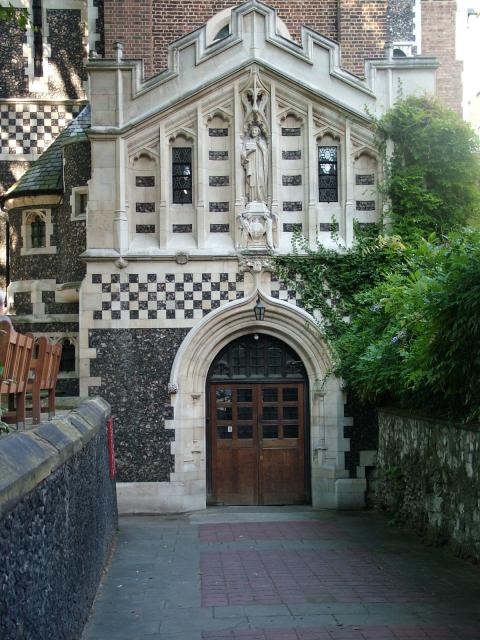
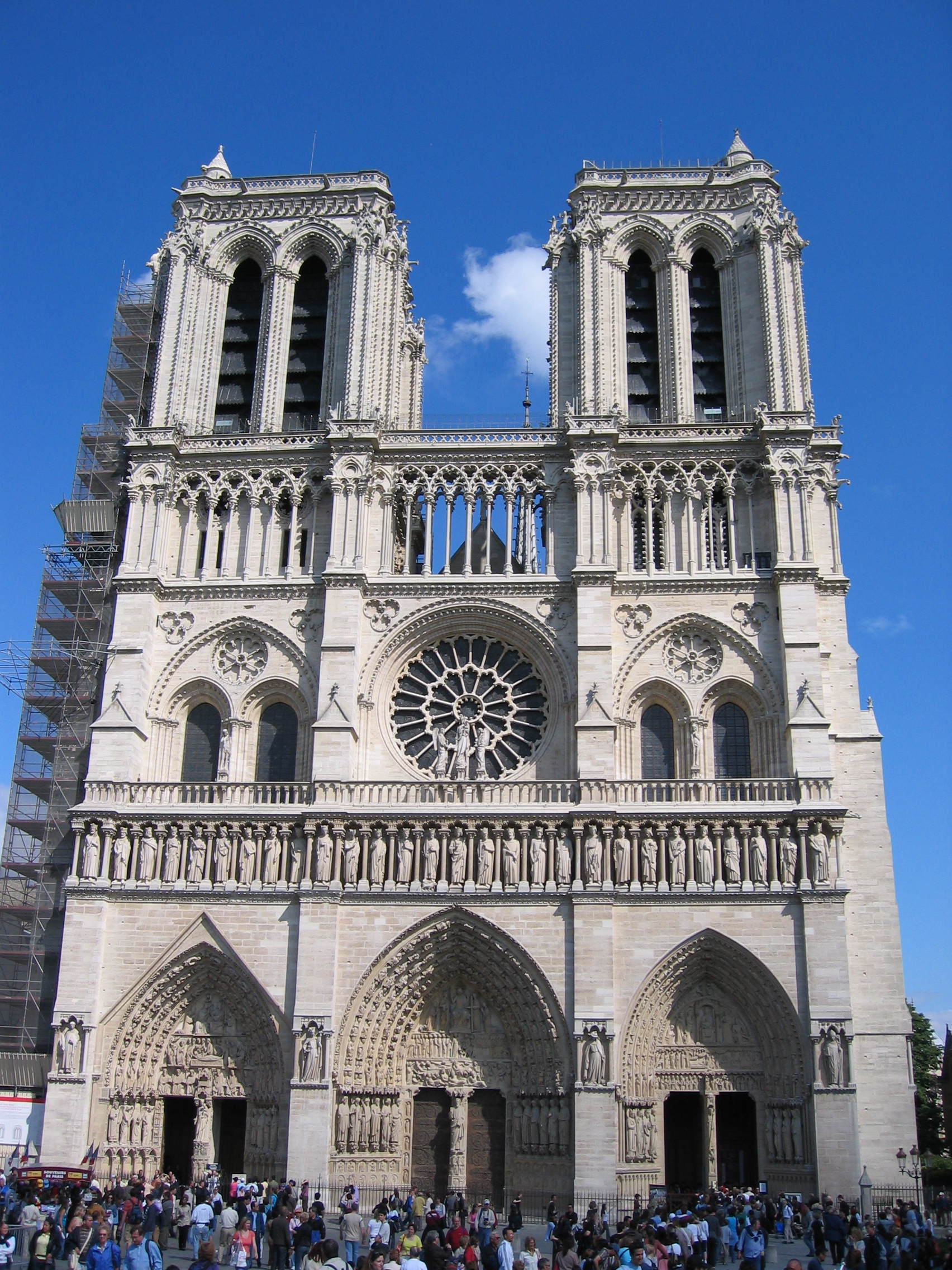
St. Bartholomew's Priory and Notre Dame Cathedral
Saturday, November 8, 2008
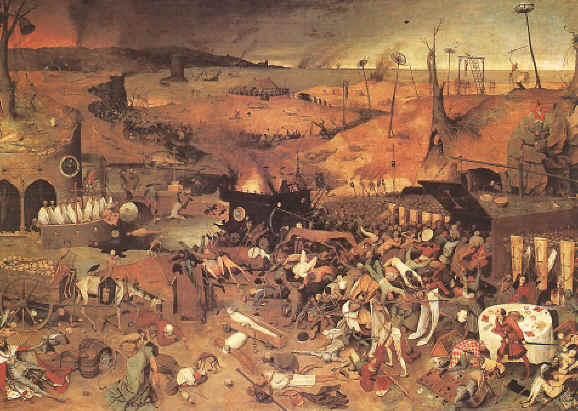
The Bubonic Plague
Most people have heard the children’s song “Ring Around the Rosy.” Little children sing it merrily, holding hands and turning about in a circle. When they reach the end of the song, the kids let go of each other and sit (or fall) down. However, most people don’t know that this song is actually about the Black Death. (Morbid little kindergarteners.) (Cantor 6)
“Ring around the rosy,
[refers to the rosy-red (or purple-ish) round rash marks on the skin —one of the first signs a person had the plague]
A pocket full of posies;
[one of the superstitious ways used by people in the Middle Ages to try and fend off the plague was to stuff their pockets with posies (flowers)]
Atischoo, atischoo,
[sneezing was also an early sign of the plague if it was a pneumonic plague; however, not all types of plague involved sneezing]
or, Ashes, ashes
[the dead were often cremated]
We all fall down.
[most of the people stricken with the plague died]” (source)
“The plague came to Europe in the fall of 1347. By 1350 it had largely passed out of western Europe. In the space of two years, one out of every three people was dead. Nothing like that has happened before or since. These general numbers disguise the uneven nature of the epidemic. Some areas suffered little, others suffered far more. Here are some examples. Between 45% and 75% of Florence died in a single year. One-third died in the first six months. Its entire economic system collapsed for a time. In Venice, which kept excellent records, 60% died over the course of 18 months: five hundred to six hundred a day at the height.” (source)

“Medical professionals calculated that dead bodies, poor ventilation, and the close quarters so common in medieval towns brought plague [besides the main cause of fleas on rats.] This led to government regulations, in particular, the decision to bury cadavers outside the town walls. Priests were told to keep sermons short and disperse congregations early.” (Gottfried 69) The people would burn the corpses, clothes, and bedding, then spray the bedroom with incense. Good smells were believed to help fight off disease.
“The disease struck and killed people with terrible speed. The Italian writer Boccaccio said its victims often ‘ate lunch with their friends and dinner with their ancestors in paradise.’” (source) “Symptoms [of the plague] include high fever, chills, headache, exhaustion, a skin rash and the namesake "buboes" — hideously enlarged and swollen lymph nodes.” (source)
“The Bubonic Plague continued to affect cities from time to time for hundreds of years. It still exists and is common among rodents. We have a cure for the disease, but occasionally people in isolated places still die from the Bubonic Plague.” (source)
Works Cited
Cantor, Norman. In the Wake of the Plague: The Black Death & the World it Made. New York: The Free Press. 2001.
Gottfried, Robert S. The Black Death: Natural and Human Disaster in Medieval Europe. New York: The Free Press. 1983.

“Ring around the rosy,
[refers to the rosy-red (or purple-ish) round rash marks on the skin —one of the first signs a person had the plague]
A pocket full of posies;
[one of the superstitious ways used by people in the Middle Ages to try and fend off the plague was to stuff their pockets with posies (flowers)]
Atischoo, atischoo,
[sneezing was also an early sign of the plague if it was a pneumonic plague; however, not all types of plague involved sneezing]
or, Ashes, ashes
[the dead were often cremated]
We all fall down.
[most of the people stricken with the plague died]” (source)
“The plague came to Europe in the fall of 1347. By 1350 it had largely passed out of western Europe. In the space of two years, one out of every three people was dead. Nothing like that has happened before or since. These general numbers disguise the uneven nature of the epidemic. Some areas suffered little, others suffered far more. Here are some examples. Between 45% and 75% of Florence died in a single year. One-third died in the first six months. Its entire economic system collapsed for a time. In Venice, which kept excellent records, 60% died over the course of 18 months: five hundred to six hundred a day at the height.” (source)

“Medical professionals calculated that dead bodies, poor ventilation, and the close quarters so common in medieval towns brought plague [besides the main cause of fleas on rats.] This led to government regulations, in particular, the decision to bury cadavers outside the town walls. Priests were told to keep sermons short and disperse congregations early.” (Gottfried 69) The people would burn the corpses, clothes, and bedding, then spray the bedroom with incense. Good smells were believed to help fight off disease.
“The disease struck and killed people with terrible speed. The Italian writer Boccaccio said its victims often ‘ate lunch with their friends and dinner with their ancestors in paradise.’” (source) “Symptoms [of the plague] include high fever, chills, headache, exhaustion, a skin rash and the namesake "buboes" — hideously enlarged and swollen lymph nodes.” (source)
“The Bubonic Plague continued to affect cities from time to time for hundreds of years. It still exists and is common among rodents. We have a cure for the disease, but occasionally people in isolated places still die from the Bubonic Plague.” (source)
Works Cited
Cantor, Norman. In the Wake of the Plague: The Black Death & the World it Made. New York: The Free Press. 2001.
Gottfried, Robert S. The Black Death: Natural and Human Disaster in Medieval Europe. New York: The Free Press. 1983.
Friday, October 31, 2008
What was the Tudor Dynasty?
“The Tudor dynasty ruled England from 1485 to 1603.” (source)
“The founder of the Tudor Dynasty was Henry VII, who emerged triumphant after the brutal Wars of the Roses which split England between the houses of Lancaster and York. This period of civil war is named for the symbols of the warring houses; Lancaster was represented by a red rose, while York was represented by a white rose. Henry VII, a relative of the House of Lancaster, managed to secure the throne in 1485, establishing the Tudor Dynasty, and he rapidly set about consolidating power in the hands of the monarch, stripping the nobility of many of their powers in the interest of avoiding future revolts and civil wars. Henry VII wisely married Elizabeth York, uniting the feuding houses, and he created a distinct symbol for the Tudor Dynasty: the Tudor Rose, which has both red and white petals, symbolizing unity.” (source)

In 1509 his son, Henry VIII, came to the throne. He married Catherine of Aragon on June 11, 1509. They had some children, but most died young. He went to war against France, and met with a little success. (source) (Elton 8)
His son, Edward VI, was his heir to the throne and became king in 1547. He was 18 at this time. “He was more ambitious than his father and spent money on warships and guns, making the English fighting fleet the best in Europe.” (source) When he wanted to divorce his first wife to marry his second, the pope refused. The king was so angry that “he broke with Rome and declared himself ‘Supreme Head of the Church.’” (source) King Edward VI married and then divorced 4 times before finally settling with his 5th wife. (Weir 26)
Next in the Tudor Dynasty came Edward VI’s cousin, Lady Jane Grey, in 1553. She was deposed only 9 days later, and then executed in 1554. After Lady Jane Grey in 1553 came Queen Mary I, daughter of Catherine of Aragon. “In December a law was passed that allowed bishops of the Church of England to sentence heretics to death by burning. Almost 300 people were burned alive during Mary’s reign with Mary’s full approval, earning her the nickname “Bloody Mary.” (source)
Her half-sister, Queen Elizabeth I, was the last of this dynasty, ruling from 1558-1603. After she died without naming an heir, the House of Stuart took over.
Works Cited
Elton, G. R. England Under the Tudors. New York: Routledge. 1992.
Weir, Alison. The Children of Henry VIII. New York: Ballantine Books. 1996.

“The founder of the Tudor Dynasty was Henry VII, who emerged triumphant after the brutal Wars of the Roses which split England between the houses of Lancaster and York. This period of civil war is named for the symbols of the warring houses; Lancaster was represented by a red rose, while York was represented by a white rose. Henry VII, a relative of the House of Lancaster, managed to secure the throne in 1485, establishing the Tudor Dynasty, and he rapidly set about consolidating power in the hands of the monarch, stripping the nobility of many of their powers in the interest of avoiding future revolts and civil wars. Henry VII wisely married Elizabeth York, uniting the feuding houses, and he created a distinct symbol for the Tudor Dynasty: the Tudor Rose, which has both red and white petals, symbolizing unity.” (source)

In 1509 his son, Henry VIII, came to the throne. He married Catherine of Aragon on June 11, 1509. They had some children, but most died young. He went to war against France, and met with a little success. (source) (Elton 8)
His son, Edward VI, was his heir to the throne and became king in 1547. He was 18 at this time. “He was more ambitious than his father and spent money on warships and guns, making the English fighting fleet the best in Europe.” (source) When he wanted to divorce his first wife to marry his second, the pope refused. The king was so angry that “he broke with Rome and declared himself ‘Supreme Head of the Church.’” (source) King Edward VI married and then divorced 4 times before finally settling with his 5th wife. (Weir 26)
Next in the Tudor Dynasty came Edward VI’s cousin, Lady Jane Grey, in 1553. She was deposed only 9 days later, and then executed in 1554. After Lady Jane Grey in 1553 came Queen Mary I, daughter of Catherine of Aragon. “In December a law was passed that allowed bishops of the Church of England to sentence heretics to death by burning. Almost 300 people were burned alive during Mary’s reign with Mary’s full approval, earning her the nickname “Bloody Mary.” (source)
Her half-sister, Queen Elizabeth I, was the last of this dynasty, ruling from 1558-1603. After she died without naming an heir, the House of Stuart took over.
Works Cited
Elton, G. R. England Under the Tudors. New York: Routledge. 1992.
Weir, Alison. The Children of Henry VIII. New York: Ballantine Books. 1996.

Saturday, October 25, 2008
The True Story of St. Nick
“Nicholas was born to wealthy parents in a tiny village in the country we today call Turkey. Though Nicholas was a child of privilege, he was raised a Christian and at a very young age was devoted to the faith. Nicholas' parents died while he was yet a boy. And not knowing what to do with himself or the fortune he inherited, he turned to his Bible and read the words of admonishment that Christ gave to a wealthy man: 'Sell all thou hath and give it to the poor and follow me.'" (source)
“Nicholas used his whole inheritance to assist the needy, the sick, and the suffering. He dedicated his life to serving God and was made Bishop of Myra while still a young man. Bishop Nicholas became known throughout the land for his generosity to those in need, his love for children, and his concern for sailors and ships.” (source)
“He is almost always seen [in paintings of him] with three bags or balls as well, symbolizing the three bags of gold he tossed through the chimney of the home of a poor man in his village for the daughters' dowry, so they would not be sold as slaves. Thus he is also seen as the ‘gift-giver.’” (source) It is said that some of these gold balls fell into the stockings that were hung up to dry. In remembrance of this, today many people put oranges in the toes of Christmas stockings. (source)
St. Nicholas died on December 6, 352 A.D. He was put into a sarcophagus at Myra. Now December 6 is celebrated by many around the world as St. Nicholas Day. (Seal 2)
So how did a kind and slender bishop become a portly man in a red suit? There are 4 steps. First, in Washington Irving’s book Knickerbocker’s History of New York, he falsely describes the man as a large, smoking Dutchman. Second, a poem called “The Children’s Friend” is published. This contained an engraving portraying St. Nick “with a thick coat, tall fur hat, and copious beard.” (Walsh 8) Third, Troy Sentinel published “A Visit from St. Nicholas” which portrays him as a fat, short, “jolly old elf.” Fourth, Thomas Nast drew multiple illustrations of the new Santa. He drew Santa wearing the clothes that we see in all Santa’s pictures today. This is how St. Nicholas became the “Santa” of modern times, and such a famous figure. (source, Walsh 8)
Works Cited
Seal, Jeremy. Nicholas: The Epic Journey from Saint to Santa Claus. New York: Bloomsbury Publishing. 2005.
Walsh, Joseph. J. Were They Wise Men or Kings?: The Book of Christmas Questions. Louisville, Kentucky: Westminster John Knox Press. 2001.
“Nicholas used his whole inheritance to assist the needy, the sick, and the suffering. He dedicated his life to serving God and was made Bishop of Myra while still a young man. Bishop Nicholas became known throughout the land for his generosity to those in need, his love for children, and his concern for sailors and ships.” (source)
“He is almost always seen [in paintings of him] with three bags or balls as well, symbolizing the three bags of gold he tossed through the chimney of the home of a poor man in his village for the daughters' dowry, so they would not be sold as slaves. Thus he is also seen as the ‘gift-giver.’” (source) It is said that some of these gold balls fell into the stockings that were hung up to dry. In remembrance of this, today many people put oranges in the toes of Christmas stockings. (source)
St. Nicholas died on December 6, 352 A.D. He was put into a sarcophagus at Myra. Now December 6 is celebrated by many around the world as St. Nicholas Day. (Seal 2)
So how did a kind and slender bishop become a portly man in a red suit? There are 4 steps. First, in Washington Irving’s book Knickerbocker’s History of New York, he falsely describes the man as a large, smoking Dutchman. Second, a poem called “The Children’s Friend” is published. This contained an engraving portraying St. Nick “with a thick coat, tall fur hat, and copious beard.” (Walsh 8) Third, Troy Sentinel published “A Visit from St. Nicholas” which portrays him as a fat, short, “jolly old elf.” Fourth, Thomas Nast drew multiple illustrations of the new Santa. He drew Santa wearing the clothes that we see in all Santa’s pictures today. This is how St. Nicholas became the “Santa” of modern times, and such a famous figure. (source, Walsh 8)
Works Cited
Seal, Jeremy. Nicholas: The Epic Journey from Saint to Santa Claus. New York: Bloomsbury Publishing. 2005.
Walsh, Joseph. J. Were They Wise Men or Kings?: The Book of Christmas Questions. Louisville, Kentucky: Westminster John Knox Press. 2001.
Sunday, October 5, 2008
The Siege of Aleppo
*It was very hard for me to find information about the siege of Aleppo. The information that I found all conflicted, also. By the time I realized that I should switch topics, I had already done too much research. >:-( >:( :( . So here’s what I understand to be the case with Aleppo:*
Modern day Aleppo

“Aleppo is a city and province in northern Syria…It is one of the oldest cities in the region, known to antiquity as Khalpe, to the Greeks as Beroea, and to the Turks as Halep, and it occupies a strategic trading point midway between the sea and the Euphrates; initially, it was built on a small group of hills in a wide fertile valley on both sides of the river Quweiq. The province or governate extends around the city for over 16,000 km and has around 3.7 million inhabitants.” (source) Today it is the second largest city in the country, with a population of about 1.7 million, followed by Damascus. (Rabbo 2)
“The main role of the city was as a trading place, as it sat at the crossroads of two trade routes and mediated the trade from India, the Tigris and Euphrates regions and the route coming from Damascus in the South, which traced the base of the mountains rather than the rugged seacoast.” (source) However, because of political reasons, they usually tried to direct the trading away from the capital some. (Meriwether 3)
“Here at Aleppo the various governors and generals of the Mamluk realm gathered with their armies and met to discuss how they might best oppose the onrushing storm [of northern invaders;] and they drew up various plans…The highways and approaches were blockaded, and guards were set on all the roads. The main body of the army was drawn up before the gates to await the conqueror's arrival.” (source)
“Timur advanced cautiously from the north, knowing through his spies that word had been sent to the Arabs, Kurds, and Turkomans to attack him from the rear; this threat never materialized. In November of 1400 (the ninth day of the first month Rabia, by the Arab chronicler's reckoning) he arrived at the outer defensive lines. The first two days of the battle were spent in minor skirmishing; Timur probed the defenses with small detachments, which were torn to pieces by the Syrian horsemen. On the third day of battle, the two armies faced off across the plain of the city; on one side the Mamluk knights of Syria and Egypt, supplemented by the citizens of Aleppo (for even the women and children went out to meet the foe); on the other the hordes of Timur, with captured war elephants from India leading the center. Both sides raised their warcry: ‘Allahu Akbar!’, ‘God is great!’” (source)
“The battle did not last one hour. Timur had sent the wings of his horde to encircle the Syrians under the cover of the previous night, and they now broke over the assembled army like a wave, shattering the orderly ranks and throwing the field into confusion. When the cowardly and treacherous Tamardash (commanding the right wing) fled the plain of battle, the Syrians broke and ran for the gates of Aleppo. Timur had prepared a tuman (ten thousand) of his finest cavalry for just such an event, and he unleashed them in pursuit. Arabshah describes the advance of the Tatar's horde:” (source)
“‘Then he went over them like a razor over hair and ran like locusts over a green crop.’ The city was overrun. The streets ran with blood; the piled dead reached the top of the walls, forming a ramp for the invaders; the many slaves of the city broke down the gates in their mad headlong flight; all the accumulated treasure of generations was carried off by the victorious men of the steppe; the Jews of the city were herded into their synagogues and slaughtered to the last man.” (source)
Timur had no mercy, so he executed all those he could capture. The siege of Aleppo was a success. After this, he stayed in the city for about a month, then went on to Damascus, leaving the ruined Aleppo behind him.
Works Cited
Meriwether, Margaret L. The Kin Who Count: Family and Society in Ottoman Aleppo, 1770-1840. Austin, Texas: University of Texas Press. 1999.
Rabbo, Anika. A Shop of One’s Own: Independence and Reputation among Traders in Aleppo (Culture and Society in Western and Central Asia.) New York City: I.B. Taurus & Co Ltd. 2005.

Timur
Modern day Aleppo

“Aleppo is a city and province in northern Syria…It is one of the oldest cities in the region, known to antiquity as Khalpe, to the Greeks as Beroea, and to the Turks as Halep, and it occupies a strategic trading point midway between the sea and the Euphrates; initially, it was built on a small group of hills in a wide fertile valley on both sides of the river Quweiq. The province or governate extends around the city for over 16,000 km and has around 3.7 million inhabitants.” (source) Today it is the second largest city in the country, with a population of about 1.7 million, followed by Damascus. (Rabbo 2)
“The main role of the city was as a trading place, as it sat at the crossroads of two trade routes and mediated the trade from India, the Tigris and Euphrates regions and the route coming from Damascus in the South, which traced the base of the mountains rather than the rugged seacoast.” (source) However, because of political reasons, they usually tried to direct the trading away from the capital some. (Meriwether 3)
“Here at Aleppo the various governors and generals of the Mamluk realm gathered with their armies and met to discuss how they might best oppose the onrushing storm [of northern invaders;] and they drew up various plans…The highways and approaches were blockaded, and guards were set on all the roads. The main body of the army was drawn up before the gates to await the conqueror's arrival.” (source)
“Timur advanced cautiously from the north, knowing through his spies that word had been sent to the Arabs, Kurds, and Turkomans to attack him from the rear; this threat never materialized. In November of 1400 (the ninth day of the first month Rabia, by the Arab chronicler's reckoning) he arrived at the outer defensive lines. The first two days of the battle were spent in minor skirmishing; Timur probed the defenses with small detachments, which were torn to pieces by the Syrian horsemen. On the third day of battle, the two armies faced off across the plain of the city; on one side the Mamluk knights of Syria and Egypt, supplemented by the citizens of Aleppo (for even the women and children went out to meet the foe); on the other the hordes of Timur, with captured war elephants from India leading the center. Both sides raised their warcry: ‘Allahu Akbar!’, ‘God is great!’” (source)
“The battle did not last one hour. Timur had sent the wings of his horde to encircle the Syrians under the cover of the previous night, and they now broke over the assembled army like a wave, shattering the orderly ranks and throwing the field into confusion. When the cowardly and treacherous Tamardash (commanding the right wing) fled the plain of battle, the Syrians broke and ran for the gates of Aleppo. Timur had prepared a tuman (ten thousand) of his finest cavalry for just such an event, and he unleashed them in pursuit. Arabshah describes the advance of the Tatar's horde:” (source)
“‘Then he went over them like a razor over hair and ran like locusts over a green crop.’ The city was overrun. The streets ran with blood; the piled dead reached the top of the walls, forming a ramp for the invaders; the many slaves of the city broke down the gates in their mad headlong flight; all the accumulated treasure of generations was carried off by the victorious men of the steppe; the Jews of the city were herded into their synagogues and slaughtered to the last man.” (source)
Timur had no mercy, so he executed all those he could capture. The siege of Aleppo was a success. After this, he stayed in the city for about a month, then went on to Damascus, leaving the ruined Aleppo behind him.
Works Cited
Meriwether, Margaret L. The Kin Who Count: Family and Society in Ottoman Aleppo, 1770-1840. Austin, Texas: University of Texas Press. 1999.
Rabbo, Anika. A Shop of One’s Own: Independence and Reputation among Traders in Aleppo (Culture and Society in Western and Central Asia.) New York City: I.B. Taurus & Co Ltd. 2005.

Timur
Subscribe to:
Posts (Atom)