Wednesday, December 5, 2007

The Philosophy of Epicurus

Epicurus taught that everyone, young and old, should seek to gain knowledge and never tire in this search. He said that to become a slave to philosophy was to gain true freedom. (source)

Epicurus believed that the universe is infinite and eternal. He said that everything in the universe is made up of indestructible atoms, making matter. They float all around, bumping and swerving. Humans themselves are nothing more than just physical interactions among these particles. “Living things are made up of particles, and it should be possible to explain the mind and its senses through the interactions between these particles. Everything happens according to the laws of nature, and not because of the divine will of any gods.” (source) (Craig 223, source)

There is a God and humans are much more than just atoms bumping into one another. We have purpose and meaning.

Epicurus once said, “Death, the most dreaded of evils, is therefore of no concern to us; for while we exist, death is not present, and when death is present, we no longer exist.” (Morris 203)

Epicurus is right that death should not be a concern to us. If one accepts Jesus, one should not be worried about death. However, when he says it isn’t a concern, look at the world. Lots of people are worried about death, and were even in his time (341-271 B.C.) He is right that death is not present when we exist. However, he is wrong when he says that when we are dead we no longer exist. There is an afterlife and we will still exist after our death on Earth. Therefore, death is of concern to us because after we die, we have no choice whether we will go to heaven or to hell anymore. Death is also not the most dreaded of evils because after we die, we can go to heaven. If one doesn’t go to heaven afterwards, that is not because of death. It is because one didn’t accept Jesus sooner.

“We usually think of charity, compassion, humility, wisdom, honor, justice, and other virtues as morally good and pleasure as, at best, morally neutral, but for Epicurus, behavior in pursuit of pleasure assured an upright life.” (source) “He taught that the point of all one's actions was to attain pleasure (conceived of as tranquility) for oneself, and that this could be done by limiting one's desires and by banishing the fear of the gods and of death. Epicurus' gospel of freedom from fear proved to be quite popular, and communities of Epicureans flourished for centuries after his death.” (source) “All that is needed for happiness is a life among friends, a body free from pain, and a peaceful mind. Living honestly brings the greatest peace of mind, and a correct understanding of nature can help free a person from needless fears and anxieties. He said that happiness can be gained by pursuing pleasure and avoiding pain. But always consider the consequences of pursuing pleasure, because some forms of pleasure result in a pain which is many times greater than any pleasure to be gained. And all things are best enjoyed in moderation. He said that it was wrong to think that just because life had no meaning that people would have no price to pay for the things they did. People are called to account throughout their lives by the judgments of others, or by the fear of being found out.” (source)

Is there nothing to life but trying to find pleasure? Is that the meaning of life? Epicurus has already established that humans themselves have no meaning because we are nothing but colliding atoms. What’s the point of living if the goal is just to try to find pleasure? How do you know when you’ve found it? Is there a standard, or should we all just have our own concept of pleasure? How far should we limit our desires? If we can never find pleasure, are we worthless? But wait, we are worthless even if we find pleasure. There are many problems with this thinking and too many unanswered questions.

“In the centuries following the death of Epicurus, some of his followers began to preach self-indulgence. They believed that we should abandon our restraints and live for the moment. The word ‘Epicurean’ came to describe someone who lived only for pleasure.” (source) That is extremely selfish! Even Epicurus said that finding pleasure included having friends. If we are true friends, we care about our comrades. A real friend doesn’t only care about themselves, but cares about the other person as well. That’s part of a solid friendship!

For those that may be lost, here's a quick summary:

· Epicurus said that everyone should seek to gain knowledge and become a slave to philosophy.
· Epicurus believed that the universe is infinite and eternal.
· He taught that living beings are just colliding atoms and that humans have no true meaning.
· He said that death should be of no concern to us because life is all there is anyway, so we should just have fun with life while we have it.
· He believed that life is about finding pleasure. Pleasure is found by limiting our desires, having peace of mind, having friends, and AVOIDING PAIN. This is a key part in his philosophy, but something impossible for humans to accomplish.
· Epicurus’ followers are called Epicureans.

Works Cited

Craig, Edward. The Shorter Routledge Encyclopedia of Philosophy. New York: Routledge. 2005.

Morris, Tom. Philosophy for Dummies. Foster City, CA: IDG Books Worldwide, Inc. 1999.

Thursday, November 29, 2007

Herodotus' role in Greece

I did my post on Plato in place of this week's. Skip!

Monday, November 19, 2007

Plato

Plato was born in Athens in 427 B.C. He was “the son of wealthy and influential Athenian parents” named Ariston and Perictione. Plato had two brothers named Adeimantus and Glaucon, as well as a younger sister named Potone. Ariston died when Plato was young. When his mother remarried, Plato found himself with a new stepbrother named Antiphon. (source)

“Plato enjoyed success in athletics and engaged in both poetry and drama.” (source) “An aristocratic man with plenty of money and a superb physique, Plato at one time won two prizes as a championship wrestler. Actually, the man’s real (and little known) name was Aristocles; Plato was just a nickname given to him by his friends, whose original connotation made reference to his broad shoulders.” (Morris 326)

However, his sort of lifestyle changed when, “around 409 B.C., Plato met Socrates and became his devoted follower.” (source) This is interesting because his uncle, Charmides, was one of Socrates’ close friends.

Socrates engaged Plato in serious questions about life such as, “What are virtue, wisdom, courage, beauty, piety, bravery, justice?” Since Socrates wrote none of his thoughts down, we must rely on Plato’s records of his dialogues.

“Following the end of the Peloponnesian war, an oligarchic tyranny called the ‘Thirty Tyrants’ ruled Athens for eight months from 404-403 B.C…[Plato’s] uncles, Critias and Charmides, belonged to the Thirty Tyrants and invited their nephew to join them. The junta was dissolved through civil war before Plato could decide.” (source)

Socrates was arrested later for undermining the religion of Athens and for “corrupting the youth.” (Video) Plato recorded Socrates’ speeches at his trial in Apology. Plato was there to witness Socrates' death of drinking a cup of hemlock in 399 B.C.

“When the master died, Plato travelled to Egypt and Italy, studied with students of Pythagoras, and spent several years advising the ruling family of Syracuse. Eventually, he returned to Athens and established his own school of philosophy at the Academy.” (source) (Craig 794)

“Socrates taught Plato, Plato taught Aristotle, Aristotle taught Alexander the Great.” (source)

“Subjects taught in the University included astronomy, biological sciences, mathematics, and political science. According to legend, his University stood in a place that was once owned by the Greek hero, Academus. That's where we began to use the term ‘academy’ when referring to schools.” (source) “For students enrolled there, Plato tried both to pass on the heritage of a Socratic style of thinking and to guide their progress through mathematical learning to the achievement of abstract philosophical truth.” (source)

Plato spent the rest of his life in charge of and teaching in his academy. He died in 347 B.C. “His end was peaceful and happy, for he is supposedly to have died in his sleep at the age of eighty after having attended the wedding feast of one of his students.” (source) (source)

Works Cited

Craig, Edward. The Shorter Routledge Encyclopedia of Philosophy. New York: Routledge. 2005.

Morris, Tom. Philosophy for Dummies. Foster City, CA: IDG Books Worldwide, Inc. 1999.

Video on Greece we watched in class


Plato (on the left) walking with Aristotle

Wednesday, November 14, 2007

Socrates

In the year of 470 B.C., Socrates was born in Athens to a stone-carver and a mid-wife. He also worked with stone, but was never as good as his father. He fought for his home city in the Peloponnesian War when he was older. (source, Schofield 63)

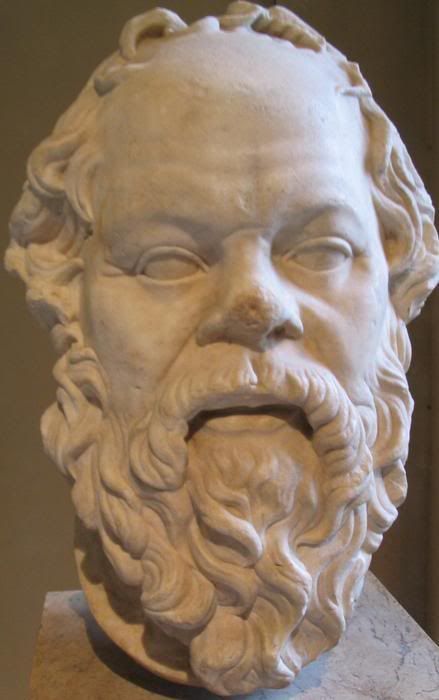
“Socrates was ugly, potbellied, had bulging eyes and a snub nose.” (source) He apparently didn’t care about his appearance or what others thought of it.

It wasn’t until he was in his forties when he began to ask serious questions about life, such as “What are virtue, wisdom, courage, beauty, piety, bravery, justice?” Some of his famous statements were “The unexamined life is not worth living” (source) and “know thyself.”

We still study Socrates’ philosophy today, examining it, agreeing and disagreeing. Some of the things that he believed we still believe today, such as having a conscience. Also, “Socrates believed in the existence of gods vastly superior to ourselves in wisdom and power.” (source) Although Christians are not polytheistic, we do believe in one God “vastly superior to ourselves in wisdom and power.” (source) (source1, source2)

Socrates introduced a way to “teach” that some still use today, called the Socratic Method. This is a “method of teaching in which the master imparts no information but asks a sequence of questions, through answering which the pupil eventually comes to the desired knowledge.” (philosophyuncc) “Socrates taught Plato, Plato taught Aristotle, Aristotle taught Alexander the Great.” (source)

Socrates didn’t write any of his thoughts down, so we have to rely on Plato’s writings of his dialogues. “Socrates believed in the superiority of argument over writing and spent the greater part of his life in the marketplace and public places of Athens. He engaged in dialogue and argument with anyone who would listen or who would submit to interrogation.” (source)

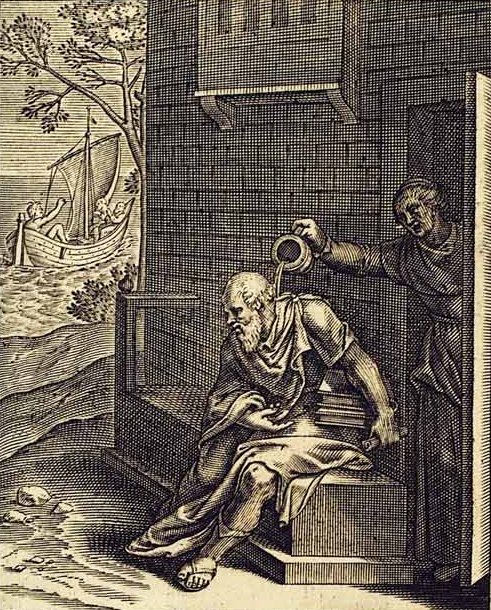
“At about fifty he married Xanthippe and had three children.” (source) Xanthippe “had a bad temper and was the worst kind of a grouch. She thought Socrates was wasting his time, that he was a loafer, as he did no work that brought in any money. One day she scolded him so loudly that he left the house, whereupon she threw a bucket of water on him. Socrates, who never answered back, merely remarked to himself: ‘After thunder, rain may be expected.’” (Hillyer 172)

However, this great philosopher’s calm life would soon change drastically. When Athens fell, Athens needed a scapegoat. They couldn’t blame the gods, so they turned to blame someone “unfaithful.” Socrates seemed like the obvious choice. (Video)

Socrates was arrested for undermining the religion of Athens and for “corrupting the youth.” (Video) When he stood up to speak, he did not apologize or plea for mercy. Rather, he said that Athens owed him something. This was not a good way to gain favor in the eyes of the 500 men in the jury. “Socrates was found guilty and sentenced to death by drinking a cup of hemlock. He turned down the pleas of his disciples to attempt an escape from prison, which had apparently been planned and only required Socrates’ willingness to escape. He did not want to. Socrates stated that he would have to flee from Athens. Having knowingly agreed to live under the city’s laws, he subjected himself to the possibility of being accused of crimes by its citizens and judged guilty by its jury. To do otherwise would cause him to break his ‘contract’ with the state, and by so doing, he felt he was harming it, which was something that went against his principles. As such, he preferred to drink the hemlock. According to Plato’s Phaedo, Socrates died [in 399 B.C.] in the company of his friends and had a calm death, enduring his sentence with fortitude.” (source)

“Soon after his death his accusers were turned upon and the state, realising their mistake, erected a statue to him.” (source)

Works Cited

Hillyer, Virgil M. A Child’s History of the World. Hunt Valley, Maryland: Calvert Education Services. 1997.

Schofield, Louise. Ancient Greece. San Francisco: Fog City Press. 2005.

Video on Greece we watched in class


Saturday, November 10, 2007

Plato's Meno

“Socrates (c.470-c.399 B.C.) [was] an Athenian philosopher. He taught his students by questions and answers and encouraged them to discuss weaknesses in the government and people’s beliefs.” (Schofield 63) Some believe that Socrates was the first person in history to know how to make a well-thought-out argument against a thought. (C.D.)

“The problem of reconstructing the life of Socrates has been compared to that of writing the life of Christ. Neither wrote a word of his teachings, which have been preserved, not always consistently, in the writings of their disciples.” (Cartledge 125) However, Plato (Socrates’s student) wrote down some of his works for him.

The work starts when Meno asks how virtue is acquired. Socrates doesn’t know what virtue is, so Meno tells him that there are different kinds of virtues for different people.
“There will be no difficulty, Socrates, in answering your question. Let us take first the virtue of a man-he should know how to administer the state, and in the administration of it to benefit his friends and harm his enemies; and he must also be careful not to suffer harm himself. A woman's virtue, if you wish to know about that, may also be easily described: her duty is to order her house, and keep what is indoors, and obey her husband. Every age, every condition of life, young or old, male or female, bond or free, has a different virtue: there are virtues numberless, and no lack of definitions of them; for virtue is relative to the actions and ages of each of us in all that we do. And the same may be said of vice, Socrates.” (source)
Socrates proves that virtue is the same for all people and argues that it should be defined as a whole, not having different things like courage and temperance being defined as virtues.

Socrates then comes in from a new angle:
“Well, I will try and explain to you what figure is. What do you say to this answer?-Figure is the only thing which always follows colour. Will you be satisfied with it, as I am sure that I should be, if you would let me have a similar definition of virtue?”(source) “Men. If you want to have one definition of them all, I know not what to say, but that virtue is the power of governing mankind.” (source) “Yet once more, fair friend; according to you, virtue is "the power of governing"; but do you not add "justly and not unjustly"? Men. Yes, Socrates; I agree there; for justice is virtue. Soc. Would you say "virtue," Meno, or "a virtue"? Men. What do you mean? Soc. I mean as I might say about anything; that a round, for example, is "a figure" and not simply "figure," and I should adopt this mode of speaking, because there are other figures. Men. Quite right; and that is just what I am saying about virtue-that there are other virtues as well as justice. Soc. What are they? tell me the names of them, as I would tell you the names of the other figures if you asked me. Men. Courage and temperance and wisdom and magnanimity are virtues; and there are many others. Soc. Yes, Meno; and again we are in the same case: in searching after one virtue we have found many, though not in the same way as before; but we have been unable to find the common virtue which runs through them all.” (source)
Socrates later brings the topic around to another point when he says,
“Is it not obvious that those who are ignorant of their [evil] nature do not desire them; but they desire what they suppose to be goods although they are really evils; and if they are mistaken and suppose the evils to be good they really desire goods?” (source)
I personally disagree with this quote because one can be doing something that they don’t know is wrong, but if they did know, would still do it anyway. In other words, one can be doing something that they don’t know is evil, but they still desire that evil thing that they are doing. Just because one is ignorant doesn’t mean one is perfect.

Meno then tries to define virtue a bit differently.
“Virtue is the desire of things honourable and the power of attaining them.” (source) “Soc. But if this be affirmed, then the desire of good is common to all, and one man is no better than another in that respect? Men. True. Soc. And if one man is not better than another in desiring good, he must be better in the power of attaining it? Men. Exactly. Soc. Then, according to your definition, virtue would appear to be the power of attaining good? Men. I entirely approve, Socrates, of the manner in which you now view this matter. Soc. Then let us see whether what you say is true from another point of view; for very likely you may be right:-You affirm virtue to be the power of attaining goods? Men. Yes. Soc. And the goods which mean are such as health and wealth and the possession of gold and silver, and having office and honour in the state-those are what you would call goods? Men. Yes, I should include all those. Soc. Then, according to Meno, who is the hereditary friend of the great king, virtue is the power of getting silver and gold; and would you add that they must be gained piously, justly, or do you deem this to be of no consequence? And is any mode of acquisition, even if unjust and dishonest, equally to be deemed virtue? Men. Not virtue, Socrates, but vice. Soc. Then justice or temperance or holiness, or some other part of virtue, as would appear, must accompany the acquisition, and without them the mere acquisition of good will not be virtue. Men. Why, how can there be virtue without these? Soc. And the non-acquisition of gold and silver in a dishonest manner for oneself or another, or in other words the want of them, may be equally virtue? Men. True. Soc. Then the acquisition of such goods is no more virtue than the non-acquisition and want of them, but whatever is accompanied by justice or honesty is virtue, and whatever is devoid of justice is vice. Men. It cannot be otherwise, in my judgment.” (source)

Socrates then goes on to ask again if Meno said that justice and temperance and the like were virtues, and he agrees, but Socrates wants a whole.

Meno later asks how we can enquire and how we know that the answer is the right one, but Socrates dismisses the question as tiresome. Socrates then says that we cannot learn, but only recall things that we already know. He demonstrates on a little boy by only asking him questions and making sure by Meno that no one else taught him those things.

Socrates says that we should enquire because we are “better and braver and less helpless if we think that we ought to enquire, than we should have been if we indulged in the idle fancy that there was no knowing and no use in seeking to know what we do not know.” (source)

Socrates asks, “wisdom is inferred to be that which profits-and virtue, as we say, is profitable? Men. Certainly. Soc. And thus we arrive at the conclusion that virtue is either wholly or partly wisdom? Men. I think that what you are saying, Socrates, is very true.” (source) Socrates comes to the conclusion that virtue is wisdom and must be taught. But he later discards it because there are no teachers, disciples, or scholars of virtue. He proves this by asking Anytus, a wise and smart aristocrat.

Socrates also says that a right opinion should be placed equal to knowledge. I personally would disagree with this because knowledge is factual. An opinion is just something that one thinks is true. If an opinion was factual, it would be knowledge, not an opinion.

Socrates concludes that virtue is not taught nor given to man by nature, so it must be God-given. This is ironic because he was later put to death for not believing in the gods, as well as “treason and corruption of the young.” (source) (source)

Works Cited

Cartledge, Paul. The Greeks: Crucible of Civilization. New York: T.V. Books, L.L.C. 2000.

C.D. we listened to in class

Schofield, Louise. Ancient Greece. San Francisco: Fog City Press. 2005.

On the left: Plato, on the right: Meno

On the left: Socrates, on the right: Atryum

Saturday, November 3, 2007

Greek Architecture


Athens had lots of new ideas coming into it because it was the center of trade during its time. “If New York City is ‘The Big Apple,’ Athens was ‘The Big Olive.’” (Video) Everyone came to them and it even started to turn into a polyglot society. However, “while absorbing what the near east had to offer…[such as architecture and religion,] the Greeks continued to make everything they took over into something astonishingly different-and original.” (Grant 11) We can see this when we look at their architecture.

“In ancient Greece, poor people and rich people lived in different kinds of houses. All houses were made of mud bricks and needed frequent repairs. Houses of the poor people were very simple compared to the houses of the rich, which had more rooms centered around a courtyard…The floors and walls in the houses were carefully created using stones, tiles, or pebbles. The nicest houses used pebbles to create mosaics. To do this, they went to the seashore and collected colored pebbles of similar sizes and arranged them in sand to make a picture or pattern on the floors or walls.”

Perhaps the most amazing parts of ancient Greek architecture were their large and gorgeous temples. We must rely on their temples for most of our information since they are one of the only surviving buildings from that time. The first stone temples appeared in large numbers during the 8th century B.C. and the 7th century B.C. “These temples were often only big enough to house a cult statue and were not meant to be places for large gatherings of people. A typical Greek temple had a long, inner chamber surrounded by columns.” “The Greek marble temples, for example, are known to have displayed blue, green, red and gold colors. The color is thought to have enhanced the optical experience of the building and to highlight the architectural sculpture.” “Beneath the temples spread public meeting places, civic buildings, gymnasiums, stadiums, theaters, and housing.” Though not much remains of these temples, we can imagine the glory they had at their peak. (source1, source2)

The three kinds of columns used by the Greeks to build these splendors and to hold up the roofs were Doric, Ionic, and Corinthian.

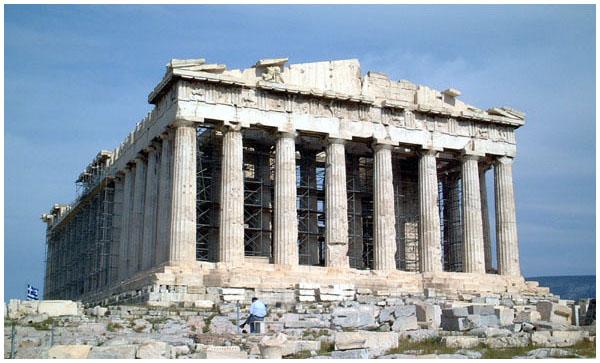
“The Doric order is plain and sturdy looking. It was developed by the Dorian tribes on the Greek mainland who were heavily influenced by buildings at Mycenae and Crete. The greatest example of Doric order is the Parthenon which was built around 440.”

“The Ionic order originated along the coast of the Asia Minor. The Ionic column is taller and more slender than the Doric. Unlike the Doric, the Ionic column has a base. The most distinctive feature of the ionic column is the scroll shape of the capitol, which made it slightly fancier than the Doric. The Ionic order was more popular in the eastern parts of Greece where there was an emphasis on elegance and ornamentation.”

“The Corinthian order was built to be sturdier than the Ionic order. It was also more decorative with elaborate leaf designs at the top of the columns. This was the style that most influenced Roman architecture” even though it wasn’t used that much in Greece.

“Some things today can be traced back to the ancient Greeks [as we have already seen,] such as theatre.” (Malam 5) The Greeks are well known for their amphitheaters. These were semi-circles “with rising tiers of seats [which look like steps] about an open space called the arena” where the orchestra would play and the actors would perform using masks to show happiness or sadness.

Many years later, one can look around and still see some of ancient Greece. “Classic Greek architecture is reflected on modern day buildings such as the Lincoln Memorial…The Lincoln Memorial uses the Doric order.” A bigger example would be the White House. “The White House is a grand mansion…with details that echo classical Greek Ionic architecture. James Hoban's original design was modeled after the Leinster House in Dublin, Ireland.” Thus we see that Greek architecture not only influenced America, but other countries as well.

Works Cited

Grant, Michael. The Founders of the Western World: A History of Greece and Rome. New York: Maxwell Macmillan Publishing Company. 1991.

Malam, John. Ancient Greece. New York: Enchanted Lion Books. 2004.

Video of Greece we watched in class

Saturday, October 27, 2007

Why were the writings of Homer so influential?

“To the classical Greeks, Homer's epics played very much the same role that the Bible plays for a lot of people today. People memorized big chunks of Homer's writings in school, and they repeated bits of it in order to convince other people to do something or think something.” “We have evidence from the classical age in Greece of people memorizing the complete poetry of Homer word for word (over 25,000 lines of poetry); it may be possible that the Homeric poems were memorized with more exactitude than scholars believe.”

“The Greeks regarded Homer as their first, and greatest, poet. They might speak of other names which pretended to greater antiquity, but they had no text to quote. For Homer they did…Homer, for the Greeks, stood at the head of their literary tradition. All knew him…” (Lattimore 13)

“The texts gave Greece a model history that became the base texts for education. Homer taught courage and honor through his poems, encouraging Greeks to be proud of their heritage.”

Not only were Homer’s writings read and valued in Greece, but we still read Homer today. Homer’s two big masterpieces were the Iliad and the Odyssey, although some scholars are doubtful if Homer was the true author of the latter. (source)

“The Iliad deals with only a small portion of the Trojan War; in fact, it covers only a few months during the tenth year of that war. The ancient Greek audience, however, would have been familiar with all the events leading up to this tenth year, and during the course of the Iliad, Homer makes many references to various past events.” (Skill 15)

“The Odyssey describes the return of the Greek hero Odysseus from the Trojan War. The opening scenes depict the disorder that has arisen in Odysseus's household during his long absence: A band of suitors is living off of his wealth as they woo his wife, Penelope. The epic then tells of Odysseus's ten years of traveling, during which he has to face such dangers as the man-eating giant Polyphemus and such subtler threats as the goddess Calypso, who offers him immortality if he will abandon his quest for home.” “The second half of the poem begins with Odysseus' arrival at his home island of Ithaca. Here, exercising infinite patience and self-control, Odysseus tests the loyalty of his servants, plots and carries out a bloody revenge on Penelope's suitors, and is reunited with his son, his wife, and his aged father.”

“The Iliad and the Odyssey are, or rather contain, the oldest Greek writings we have. There is no way to date accurately any part of them. Scholars differ widely, and will no doubt continue to do so.” (Hamilton 21)

The Iliad and the Odyssey are important because they record Greek (and Trojan) history. From the rage of Achilles to Odysseus’ return to Ithaca, these epic poems hold precious history and show us the lifestyles and beliefs of these famous characters.

Works Cited

Hamilton, Edith. Mythology: Timeless Tales of Gods and Heroes. New York: New American Library. 1969.

Lattimore, Richmond. The Iliad of Homer. Chicago: The University of Chicago Press. 1951.

Skill, Elaine Strong. Cliff’s Notes on Homer’s The Iliad. Lincoln, Nebraska: Cliff’s Notes, Inc. 1986.

Left: part of the Iliad on papyrus


Right: part of the Odyssey on papyrus